The Automated CFO: How AI Agents Are Reshaping C-Suite Financial Strategy
By Dan Gudkov | September 1, 2025 | 7 min read
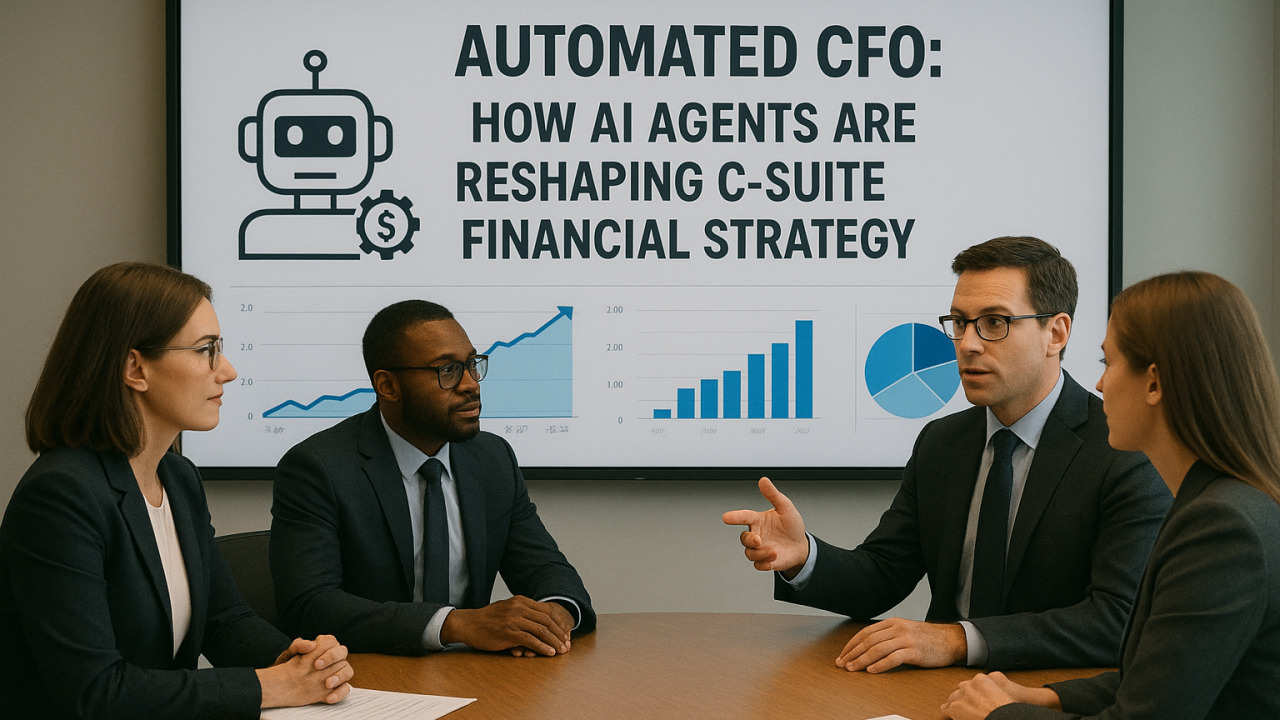
AI agent networks are transforming financial operations at an unprecedented pace. The market for AI-powered financial automation is projected to explode from $0.87 billion to $80 billion by 2034, representing a structural shift in how corporate finance functions.
Key Takeaways
- AI agents are transitioning from rigid RPA scripts to adaptive, cognitive multi-agent networks that understand business context.
- By automating the repetitive 'document plumbing' layer, organizations can reduce month-end close times from weeks to minutes.
- Cognitive leverage allows finance departments to scale capacity and revenue without linearly growing headcount.
- CFOs are freed from backward-looking transaction tracking to focus on forward-looking capital allocation and dynamic forecasting.
Beyond RPA: The Rise of Cognitive Financial Orchestration
For the past decade, corporate finance departments have relied on Robotic Process Automation (RPA) to streamline operations. While RPA was a step forward, it suffered from a fundamental flaw: rigidity. RPA bots are built on fixed rules and hardcoded scripts. If a vendor changed their invoice layout by even a few pixels, or if an email attachment arrived in a slightly different format, the automation broke, requiring developer intervention.
Today, we are witnessing the transition from RPA to Cognitive Financial Orchestration driven by Large Language Models (LLMs) and autonomous AI agent networks. These modern systems do not just follow static templates; they understand context. They can read messy real-world documents, interpret handwritten notes, and handle non-standard layouts with over 99% accuracy.
Instead of a single monolithic bot, modern organizations deploy collaborative multi-agent networks. Within these networks, specialized AI agents cooperate: one coordinates document ingestion, another parses and extracts line items, a third reconciles the data against purchase orders, and a final agent drafts follow-up communications. This distributed architecture mirrors a human operations team, executing complex workflows in parallel with unprecedented adaptability.
The Headcount Leverage: Scaling Without Linear Hiring
Traditional service businesses and corporate departments scale linearly. To handle 2x more invoices, manage 2x more vendors, or support 2x more clients, you typically need to hire nearly twice as many people. This linear relationship severely caps profit margins and makes rapid scaling prohibitively expensive, especially in a tight labor market.
Autonomous financial agents break this bottleneck by providing cognitive leverage. Rather than doing the repetitive data entry, human finance professionals shift their role to supervising the AI pipeline. They review a small queue of exceptions, while the agent network automatically ingest, parses, codes, and posts 95% of standard transactions.
This paradigm shift fundamentally changes the unit economics of the finance department. A single accountant or bookkeeper can oversee far more transactions because their manual burden is virtually eliminated. This allows the business to scale its operations and margins exponentially, uncoupling growth from department headcount.
Accelerating the Close Cycle: Real-Time Bookkeeping
The month-end close is a notorious bottleneck for most companies. It is a stressful, manual sprint that typically takes 10 to 15 days of downloading bank statements, hunting for missing receipts, matching transactions, and adjusting journals. Because of this lag, executive leadership often navigates the business using financial data that is already several weeks out of date.
With autonomous AI agents, bookkeeping happens in real-time. As invoices are received, receipts uploaded, and statements downloaded throughout the month, the agent network processes them instantly. It extracts data, validates it, codes it against the QuickBooks Chart of Accounts, and prepares the entries in the background.
When month-end arrives, there is no massive backlog of documents to reconcile. The close is already virtually complete. The team simply reviews the real-time dashboards, addresses a few edge-case anomalies, and locks the books. What used to take weeks is accomplished in a matter of minutes, providing leadership with instant, accurate visibility to steer the company.
The CFO as a Strategic Value Navigator
When the finance department is no longer buried under a mountain of paper and manual data reconciliation, the role of the CFO undergoes a profound transformation. Historically, CFOs have spent a significant portion of their energy ensuring compliance, auditing past data, and acting as historians of the balance sheet.
The automated CFO office enables the C-suite to shift from reactive tracking to proactive strategic steering. With real-time cash flow metrics, dynamic forecasting models, and instant margin analysis at their fingertips, CFOs can provide high-value strategic guidance. They can focus on capital allocation, tax optimization, and long-term risk mitigation.
The future belongs to organizations that treat finance as a strategic asset rather than an administrative cost center. By deploying autonomous AI agent networks to handle the compliance and bookkeeping plumbing, forward-looking CFOs can unlock massive organizational capacity and navigate volatile markets with agility and confidence.
More articles
The Annual ROI of Automation: Reclaiming 120 Hours of Founder Time
By DoDocs Editorial Team | October 19, 2026 | 3 min read
From Chasing Clients to Supervising Systems: Managing Modern Accounting Teams
By DoDocs Editorial Team | October 19, 2026 | 3 min read
Scaling Your Fractional Accounting Firm: Reclaiming 30+ Hours per Week per Bookkeeper
By DoDocs Editorial Team | October 19, 2026 | 3 min read