Why 100% Autonomous AI is a Myth: The Review-by-Exception Model
By DoDocs Editorial Team | October 5, 2026 | 5 min read
Why 100% Autonomous AI is a Myth: The Review-by-Exception Model
In the current gold rush of AI-driven financial technology, there is a tempting narrative being sold to CFOs and founders: the "set-it-and-forget-it" back office. The promise of 100% autonomous AI bookkeeping suggests a world where software handles every edge case, every missing receipt, and every complex tax treatment without a single human intervention.
But for those who have managed a complex ledger, this narrative feels less like a future reality and more like a dangerous oversimplification. At DoDocs, we believe that 100% autonomy is a myth that ignores the inherent complexity of corporate finance. Instead, the gold standard for high-growth companies is the Review-by-Exception accounting model.
The Mirage of Total Autonomy
The dream of total autonomy fails because accounting isn't just about data entry; it’s about judgment. While an AI agent can extract a date and amount from an invoice with 99.9% accuracy, it cannot always know the intent or the context behind a transaction without human guidance.
Is a $2,000 charge for a "Team Retreat" a marketing expense, a travel expense, or a fringe benefit? The answer depends on the company’s internal policy, the current tax jurisdiction, and even the strategic goals of the quarter. A system that claims 100% autonomy often hides its errors behind a curtain of automation, leading to "drift" in the ledger that isn't caught until a high-stakes audit.
What is Review-by-Exception Accounting?
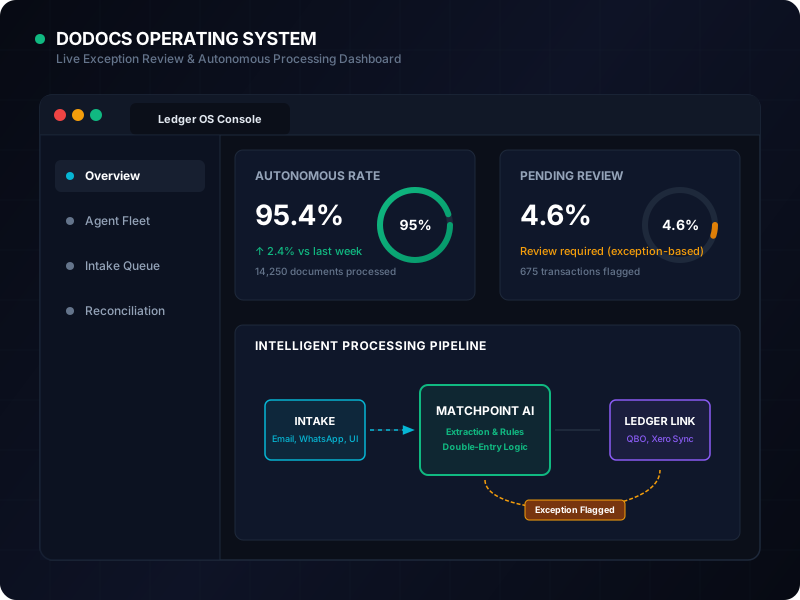
Review-by-Exception (RbE) is a paradigm shift in how finance teams interact with technology. Instead of a human bookkeeper touching every single transaction to verify its accuracy, the AI handles the vast majority of standard, high-confidence work. The human is only alerted when the system encounters an "exception"—a transaction that falls below a specific confidence threshold or triggers a complex rule.
In this model, the AI acts as the "first responder," processing 95% to 98% of the volume autonomously. The remaining 2% to 5% are presented to the human controller in a "Review Queue."
The Mechanics of an Exception
An exception isn't necessarily an error. It is a signal that a transaction requires professional judgment. Common exceptions include:
- Novel Vendors: A vendor the system hasn't seen before that doesn't clearly map to the Chart of Accounts.
- Rule Conflicts: When a transaction matches a bank feed but conflicts with a specific company spending policy.
- Low Confidence Extraction: When a document is blurry or carries ambiguous line items that the AI refuses to guess on.
- Strategic Thresholds: Any transaction over a certain dollar amount (e.g., $10,000) that requires a second pair of eyes regardless of AI confidence.
Why RbE Leads to 99.4% Precision Ledgers
The primary benefit of the Review-by-Exception model is that it eliminates the "fatigue" of manual bookkeeping. When a human has to click "Approve" on 1,000 identical Starbucks receipts, their attention wanes. When they are only asked to look at 10 complex, high-value discrepancies, they bring their full cognitive power to the task.
By focusing human talent only where it is needed most, firms can achieve 99.4% precision ledgers. The AI provides the scale and speed, while the human provides the final "seal of integrity." This is the "Human-in-the-Loop" architecture that separates enterprise-grade AI from simple automation tools.
The ROI of Human Oversight
There is a common fear that requiring human review "slows down" the process. In reality, it accelerates it.
The Review-by-Exception model allows a single bookkeeper to manage 10x the number of clients they could handle previously. Because they aren't bogged down by data entry, they can focus on high-value advisory work. For the business owner, this means faster month-end closes and real-time visibility into their cash flow, backed by the peace of mind that a professional has audited the outliers.
Conclusion: Trust, but Verify
The future of finance is not about replacing humans with machines; it's about augmenting human judgment with machine-scale processing. 100% autonomy is a liability in a world of strict compliance and complex tax laws.
The Review-by-Exception model is the bridge between the manual past and the autonomous future. It acknowledges that while AI is incredibly powerful, the ultimate accountability for the books still rests with the human professional. At DoDocs, we don't build "black boxes"—we build transparent, agentic networks that know when to act and, more importantly, when to ask for help.
SEO Metadata:
- Primary Keyword: Review-by-Exception accounting
- Meta-Title: The Review-by-Exception Model in AI Accounting | DoDocs
- Meta-Description: Explore why 100% autonomous AI in bookkeeping is a myth. Learn how the Review-by-Exception model ensures human oversight and 99.4% precision ledgers.
More articles
The Annual ROI of Automation: Reclaiming 120 Hours of Founder Time
By DoDocs Editorial Team | October 19, 2026 | 3 min read
From Chasing Clients to Supervising Systems: Managing Modern Accounting Teams
By DoDocs Editorial Team | October 19, 2026 | 3 min read
Scaling Your Fractional Accounting Firm: Reclaiming 30+ Hours per Week per Bookkeeper
By DoDocs Editorial Team | October 19, 2026 | 3 min read